Updated field direction
The field has increasingly moved from simple detection of translocation events towards quantitative, interpretable and multi-modal readout. Modern nanopore experiments do not only ask whether a molecule passes through a pore; they ask how the molecule moves, how local features are mapped onto the signal, and how experimental conditions can be adjusted to improve resolution. This is especially important for applications involving molecular barcodes, labelled DNA carriers, short nucleic acids, protein-nucleic-acid complexes and future electro-optical sensing platforms.
Contribution 1: conceptual framework
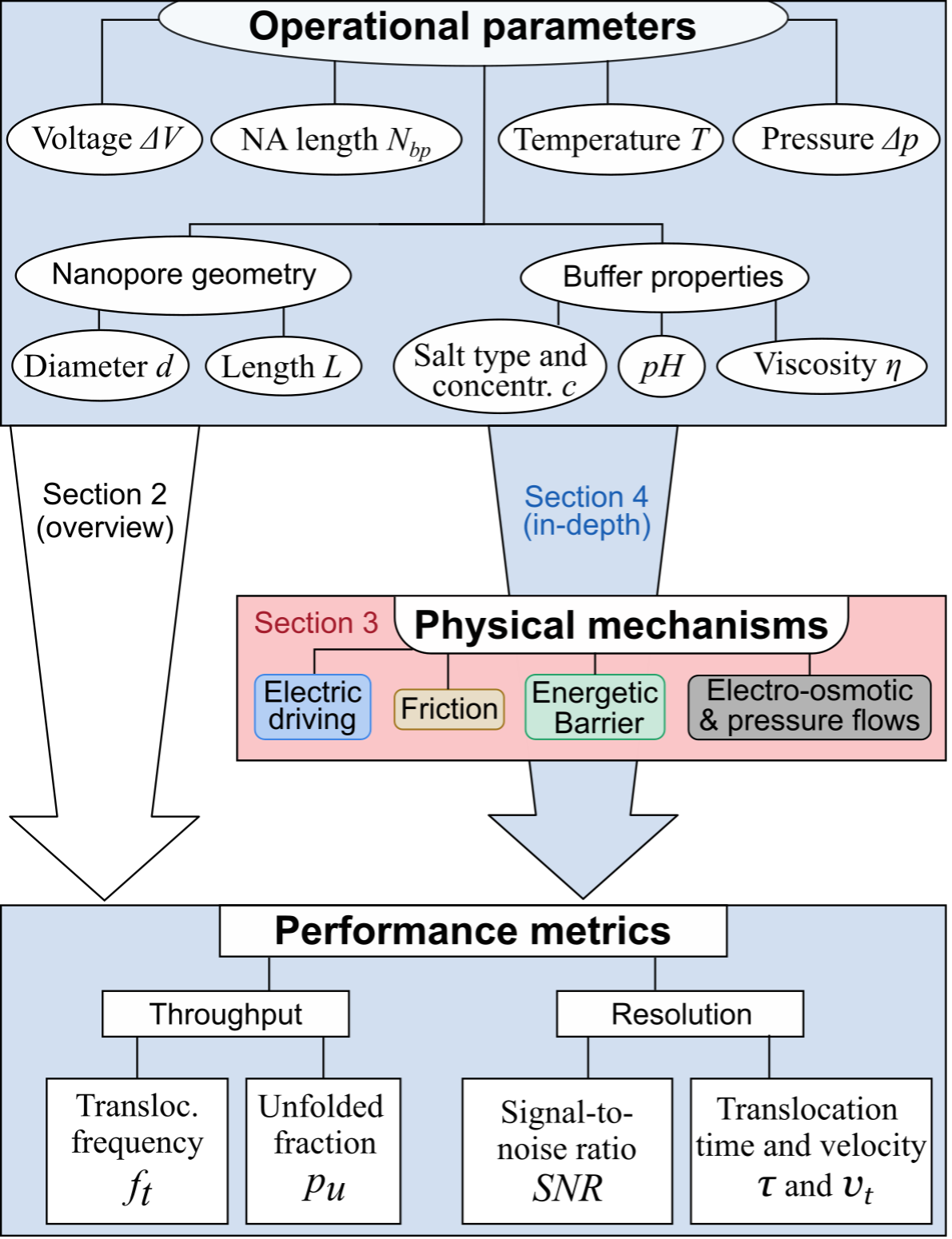
The first major contribution of the PhD work was a comprehensive review of double-stranded nucleic-acid translocation through solid-state nanopores, now published in Physics of Life Reviews [1]. The review organised the field around the physical processes that determine translocation, including electrophoretic driving, hydrodynamic drag, electro-osmotic effects, polymer conformation, pore geometry, folding and signal formation. This provided a broad framework for interpreting nanopore experiments and for identifying which transport effects matter for future high-resolution sensing.
Contribution 2: molecular labels and readout
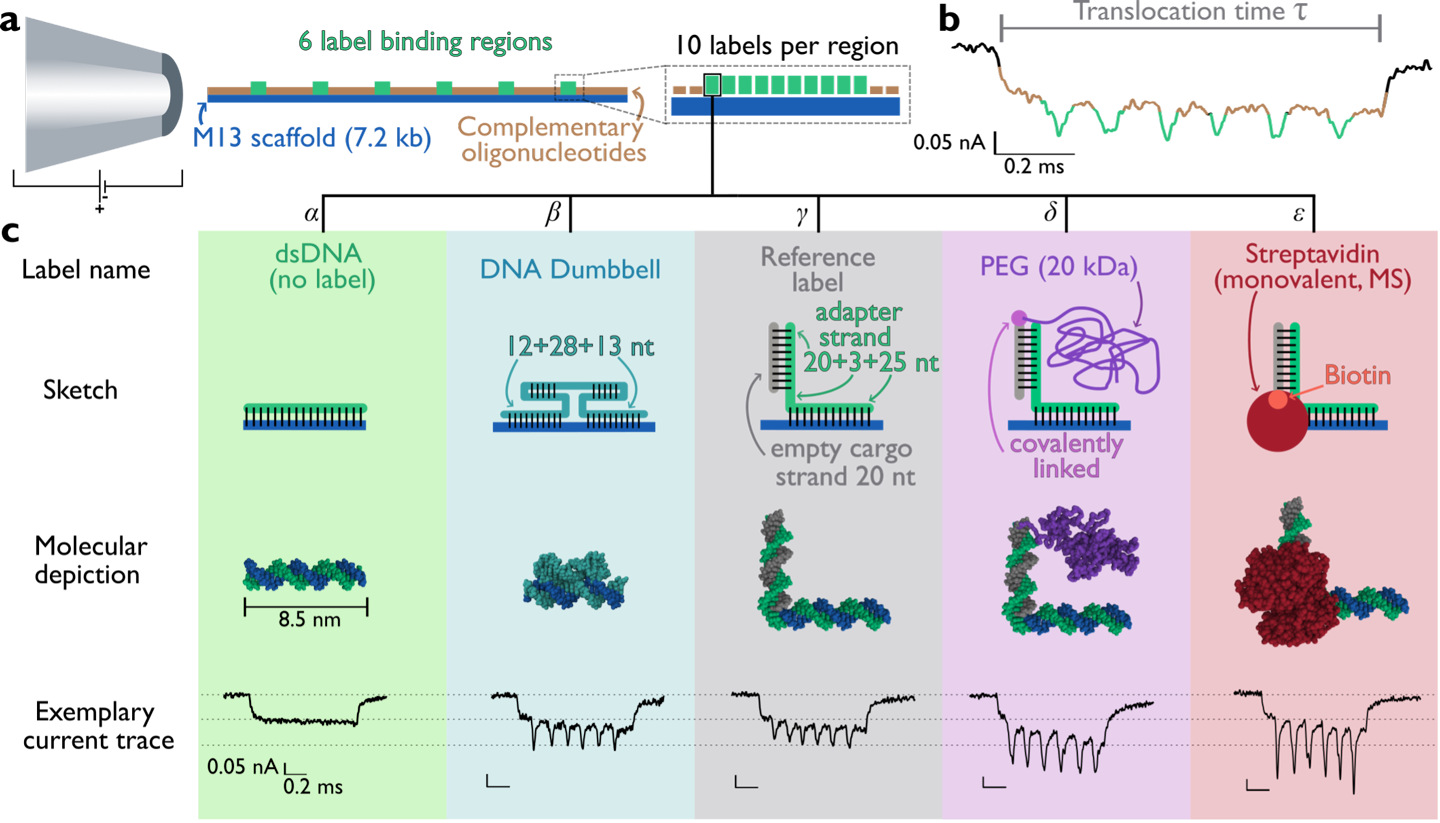
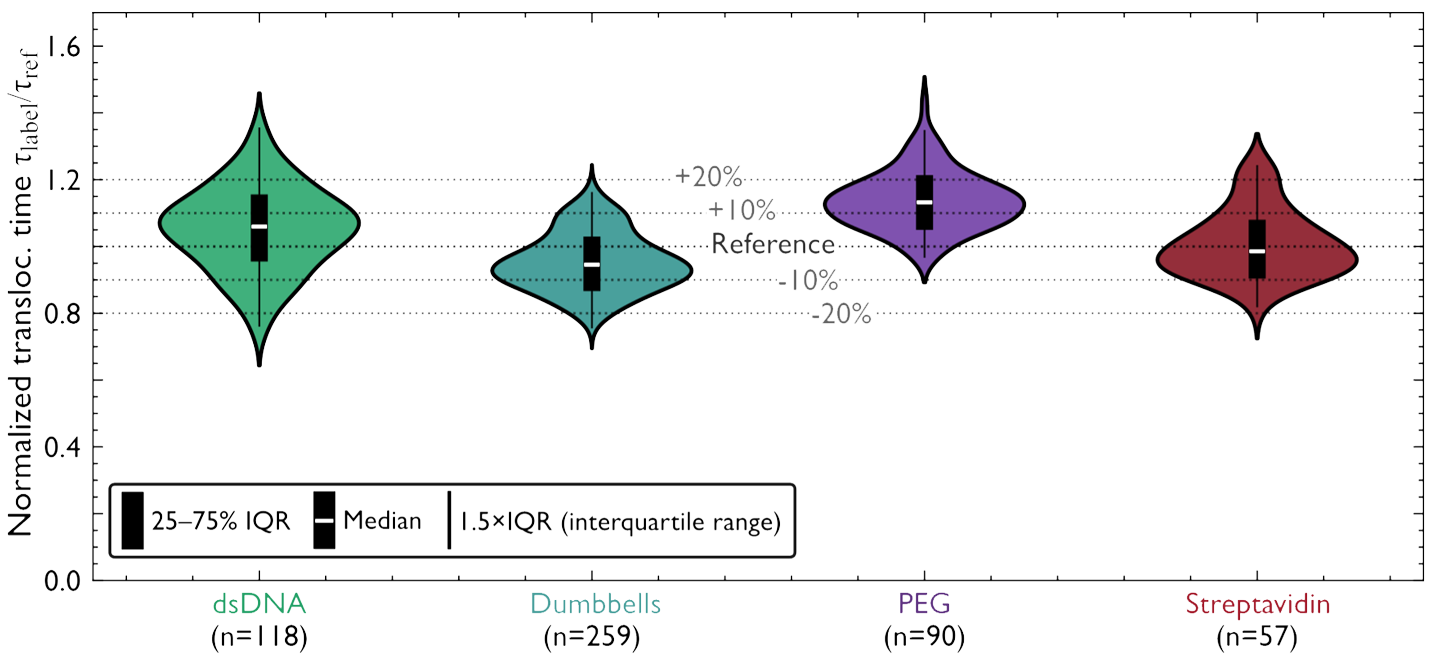
A second contribution was an experimental study of how dense molecular labelling affects DNA translocation. Labels are central to many nanopore readout strategies because they can encode sequence position, protein binding or structural information along a carrier molecule. The work showed that dense labelling can leave the global translocation time largely preserved, and the overall velocity profile is preserved across labels. This result is important for designing labelled nanopore assays: labels can be used for obtaining positional and structural information without needing label-specific corrections. [2]
Contribution 3: transport control and electrohydrodynamics
Ongoing work extends this theme by investigating stronger slowdown mechanisms and investigating electro-osmotic flow in nanopore systems with a custom designed electro-optical setup with unprecedented flow resolution, in collaboration with JR(?). Slowing molecules down is directly relevant to the original DYNAMO challenge, because longer residence times increase the time available for electrical or optical interrogation. Electro-osmotic flow measurements are also important because flow can either assist or oppose electrophoretic motion and can vary with salt type, concentration, pH and pore geometry. Understanding these effects helps explain why the same molecule may behave differently under different nanopore conditions. We also demonstrated the passage of multiple DNA&RNA sequences in parallel through two coupled nanopores, one of the key deliverables, demonstrating scalability of the approach.
Relevance to DYNAMO
Taken together, the PhD work contributes to the DYNAMO objective of improved single-molecule nanopore readout by addressing the transport bottleneck that underlies electro-optical detection. The work does not merely optimise one assay; it clarifies the physical conditions required for reliable readout of nucleic acids and molecular features through nanopores. This provides a basis for future implementations in which optical or plasmonic signals are combined with electrical detection to identify short nucleic acids, sequence-dependent features or molecular modifications.
Selected Output
- [1] Brauburger and Keyser, A biophysicist's guide to translocation of double-stranded nucleic acids through solid-state nanopores, Physics of Life Reviews, 2026.
- [2] Brauburger et al., Label type influence on DNA translocation velocity in solid-state nanopores, submitted revisions, ACS Nano, 2026